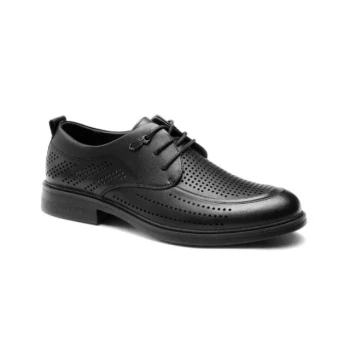
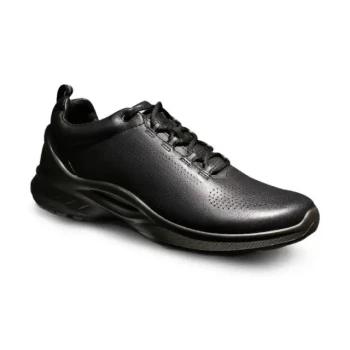
Ultimately, no single type of shoe is inherently better than another. The most effective choice is not based on a universal standard but is a deeply personal decision. It depends entirely on your unique anatomy, your intended activity, and your awareness of what different shoe designs offer.
The search for a universally "best" shoe is a flawed premise. The goal is to find the right shoe for you, which requires understanding the fundamental trade-offs between core design philosophies like cushioning, stability, and ground-feel.
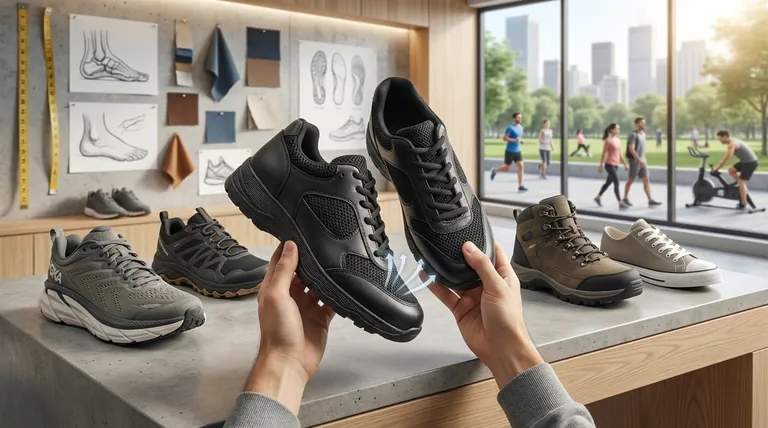
Beyond "Good" vs. "Bad": A Spectrum of Design
Choosing a shoe isn't about finding a perfect product, but rather finding the right point on a spectrum of design philosophies. Each approach offers distinct benefits and serves a different purpose.
The Core Dichotomy: Cushioning vs. Ground-Feel
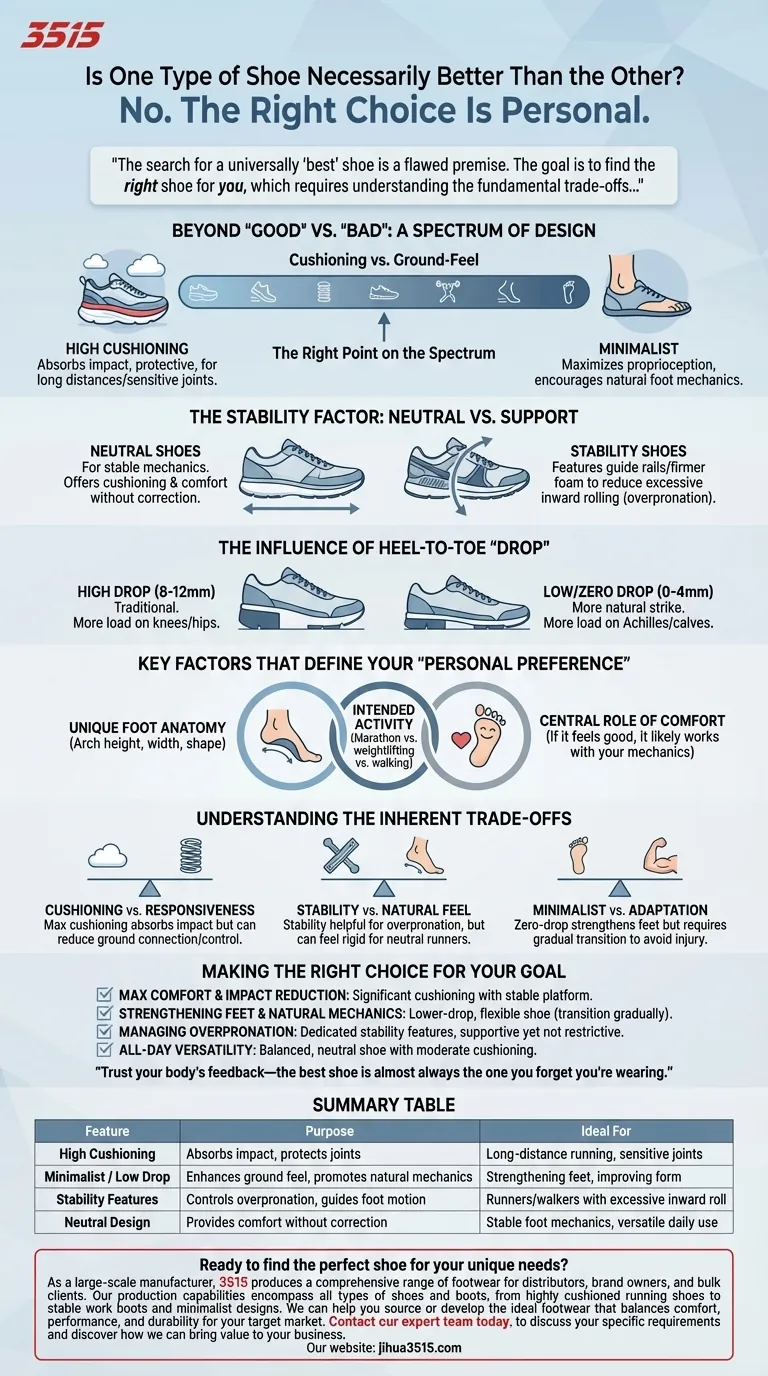
Highly cushioned shoes are designed to absorb impact, providing a soft, protective experience that can be beneficial for long distances or sensitive joints.
Conversely, minimalist shoes offer very little cushioning. Their purpose is to maximize proprioception, or your foot's ability to feel the ground, encouraging more natural foot mechanics.
The Stability Factor: Neutral vs. Support
Neutral shoes are built for individuals with stable foot mechanics. They offer cushioning and comfort without actively trying to correct the foot's motion.
Stability shoes, on the other hand, incorporate features like guide rails or firmer foam (medial posts) on the inner side of the shoe. These are designed to gently guide the foot and reduce excessive inward rolling, a motion known as overpronation.
The Influence of Heel-to-Toe "Drop"
"Drop" refers to the height difference between the heel and the forefoot of a shoe.
A high drop (8-12mm) is traditional in many running and walking shoes, placing more load on the knees and hips. A low or zero drop (0-4mm) promotes a more natural, midfoot strike but places more load on the Achilles tendon and calf muscles.
Key Factors That Define Your "Personal Preference"
The vague concept of "personal preference" becomes clear when you break it down into three critical components.
Your Unique Foot Anatomy
Factors like your arch height (high, neutral, or flat), foot width, and overall shape are the primary determinants of a good fit. A shoe praised by others may be entirely wrong for your foot type.
The Intended Activity
The demands of running a marathon are vastly different from those of a weightlifting session or a day spent walking on concrete. A shoe's design—its flexibility, support, and cushioning—must match the forces and movements of your activity.
The Central Role of Comfort
Do not underestimate subjective comfort. If a shoe feels good, it is likely working in harmony with your body's natural mechanics. Discomfort, pinching, or rubbing are clear signals of a poor match.
Understanding the Inherent Trade-offs
Every design choice in footwear comes with a corresponding compromise. Acknowledging these trade-offs is essential for making an informed decision.
Cushioning Can Reduce Responsiveness
Maximum cushioning provides excellent impact absorption. However, that thick layer of foam can sometimes feel unstable or dampen your connection to the ground, reducing your sense of control.
Stability Features Can Feel Intrusive
For someone who overpronates, stability mechanisms are incredibly helpful. For a neutral runner, that same technology can feel rigid, restrictive, and unnatural.
Minimalist Designs Require Adaptation
Shifting to a zero-drop or low-cushion shoe can help strengthen your feet. However, it requires a gradual transition period to allow your muscles and tendons to adapt, otherwise you risk injury.
Making the Right Choice for Your Goal
Instead of asking "What is the best shoe?", ask "What is the best shoe for my specific goal?".
- If your primary focus is maximum comfort and impact reduction: Opt for a shoe with significant cushioning, but ensure it still provides a stable platform for your foot.
- If your primary focus is strengthening your feet and improving natural mechanics: Consider a lower-drop, more flexible shoe and be sure to transition into it gradually over weeks or months.
- If your primary focus is managing overpronation: Look for models with dedicated stability features and confirm they feel supportive without being restrictive.
- If your primary focus is all-day versatility: A balanced, neutral shoe with moderate cushioning often provides the best combination of comfort and function for varied daily activities.
Trust your body's feedback—the best shoe is almost always the one you forget you're wearing.
Summary Table:
| Feature | Purpose | Ideal For |
|---|---|---|
| High Cushioning | Absorbs impact, protects joints | Long-distance running, sensitive joints |
| Minimalist / Low Drop | Enhances ground feel, promotes natural mechanics | Strengthening feet, improving form |
| Stability Features | Controls overpronation, guides foot motion | Runners/walkers with excessive inward roll |
| Neutral Design | Provides comfort without correction | Stable foot mechanics, versatile daily use |
Ready to find the perfect shoe for your unique needs?
As a large-scale manufacturer, 3515 produces a comprehensive range of footwear for distributors, brand owners, and bulk clients. Our production capabilities encompass all types of shoes and boots, from highly cushioned running shoes to stable work boots and minimalist designs. We can help you source or develop the ideal footwear that balances comfort, performance, and durability for your target market.
Contact our expert team today to discuss your specific requirements and discover how we can bring value to your business.
ビジュアルガイド
関連製品
- 高トラクションクリートゴム底の卸売耐久性迷彩キャンバスシューズ
- 鋼鉄製先芯・防滑・ロータリーレーシングシステム搭載 高機能KPU製アスレチックセーフティシューズ
- 卸売現代穴あき革ダービー靴カスタム ブランド チャンキーソール
- 大量注文のためのダイヤルクロージャーシステムと卸売モダンなビジネスシューズ
- 工場直接卸し売りダイヤルの閉鎖が付いている革慰めの靴