
In motorcycle boots, material choice is the single most critical factor that dictates the balance between rider safety, comfort, and long-term durability. High-quality materials like full-grain leather provide superior resistance to abrasion in a slide, while advanced synthetic textiles offer advantages in weight, breathability, and weatherproofing. The material directly determines how the boot will perform its primary job: protecting you from injury.
The central decision in choosing a motorcycle boot is not about finding the "best" material, but about understanding the inherent trade-offs between maximum protection, rider comfort, and suitability for your specific riding environment.
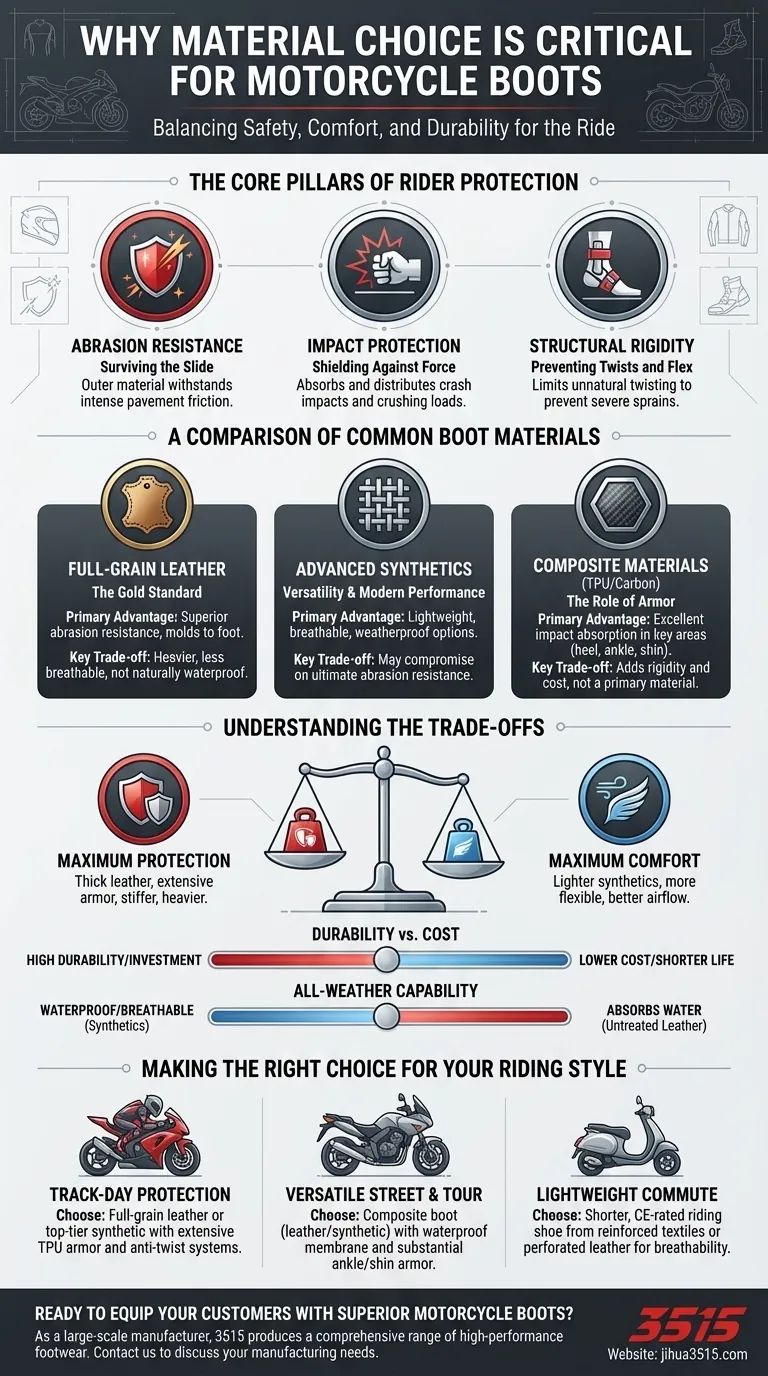
The Core Pillars of Rider Protection
A motorcycle boot is a piece of technical safety equipment. Its material composition is engineered to defend against the specific forces involved in a crash.
Abrasion Resistance: Surviving the Slide
When you fall from a moving motorcycle, you don't just hit the ground—you slide. The boot's outer material must withstand the intense friction of pavement, which can shred lesser materials in seconds. This is the primary function of the boot's main chassis.
Impact Protection: Shielding Against Force
A crash often involves sudden, hard impacts. This could be your foot hitting the ground, being struck by another vehicle, or being crushed under your own motorcycle. The boot's materials must be able to absorb and distribute this force to prevent fractures.
Structural Rigidity: Preventing Twists and Flex
Your ankle is vulnerable to unnatural twisting and hyper-extension. The materials and construction of a good boot provide a rigid structure that limits this movement, effectively acting as an exoskeleton to prevent severe sprains and ligament damage.
A Comparison of Common Boot Materials
Different materials are chosen to optimize for different performance characteristics. Modern boots often use a combination of materials to achieve a balance of features.
Full-Grain Leather: The Gold Standard
For decades, high-quality leather has been the benchmark for protection. It offers exceptional abrasion resistance and, over time, molds to the rider's foot for a custom fit. Its primary drawback is its weight and lack of natural breathability or waterproofing.
Advanced Synthetics: Versatility and Modern Performance
Materials like microfiber, Lorica, and Cordura are common in modern boots. They can be engineered to be lighter, more breathable, and often more water-resistant than leather. While high-end synthetics offer excellent protection, cheaper variants may not match the abrasion resistance of top-tier leather.
Composite Materials: The Role of Armor
Neither leather nor synthetics alone are sufficient for impact protection. This is why boots incorporate armor made from Thermoplastic Polyurethane (TPU) or carbon fiber. These hard components are placed in critical areas like the heel, ankle, and shin to absorb impact and provide structural support.
Understanding the Trade-offs
Choosing a boot material is always an exercise in balancing competing priorities. There is no single material that excels in every category.
Protection vs. Comfort
The most protective boots, often made of thick leather with extensive external armor, are typically heavier, stiffer, and less breathable. Lighter, more flexible synthetic boots provide more off-bike comfort and airflow but may represent a compromise in ultimate abrasion resistance.
Durability vs. Cost
Full-grain leather boots are an investment. They often cost more upfront but can last for many years with proper care. Synthetic boots may be more affordable, but their lifespan can be shorter, especially under hard use.
All-Weather Capability
Untreated leather absorbs water, becoming heavy and cold. Many synthetic boots, by contrast, incorporate waterproof and breathable membranes (like Gore-Tex), making them a far superior choice for riders who face varied weather conditions.
Making the Right Choice for Your Riding Style
Your decision should be guided by your primary use case.
- If your primary focus is maximum track-day protection: Choose a boot made from full-grain leather or a top-tier synthetic, featuring extensive external TPU armor and anti-twist systems.
- If your primary focus is versatile street and tour riding: Look for a composite boot (leather or synthetic) that includes a waterproof membrane and has substantial, well-integrated ankle and shin armor.
- If your primary focus is lightweight commuting and warm weather: Consider a shorter, CE-rated riding shoe made from reinforced textiles or perforated leather that prioritizes breathability while still offering core protection.
Ultimately, selecting the right material means you are investing directly in the safety and comfort of every ride you take.
Summary Table:
| Material | Primary Advantage | Key Trade-off | Best For |
|---|---|---|---|
| Full-Grain Leather | Superior abrasion resistance | Heavier, less breathable | Maximum protection (track days) |
| Advanced Synthetics | Lightweight, breathable, weatherproof | May compromise on abrasion resistance | Versatile street/touring riding |
| Composite (TPU/Carbon) | Excellent impact absorption | Adds rigidity and cost | All styles (used as armor in key areas) |
Ready to Equip Your Customers with Superior Motorcycle Boots?
As a large-scale manufacturer, 3515 produces a comprehensive range of high-performance footwear for distributors, brand owners, and bulk clients. Our production capabilities encompass all types of motorcycle boots and shoes, engineered with the right materials for optimal safety and comfort.
Contact us today to discuss your manufacturing needs and provide your customers with the protection they demand.
ビジュアルガイド
関連製品
- 卸売タクティカルブーツ高トラクション&一括&ブランド注文のための反射
- 高性能難燃防水安全ブーツ
- 耐久性グッドイヤーウェルトレザーワークブーツ卸売-プライベートブランド
- 卸売高トラクションカモブーツ - ブランドカスタムメーカー
- バルク供給用ヘビーデューティー防水ヌバック安全ブーツ 安全靴



















